




EVA Foam Sticker Production Guide
Understanding Production Methods and Uses
EVA foam stickers are craft, educational, and decorative components made by adding an adhesive layer to lightweight, soft EVA foam and cutting it into the desired shape. Compared with ordinary paper stickers, they have thickness and dimension, making them widely used for children’s crafts, teaching aids, event decorations, package decoration, DIY kits, and more.
EVA foam stickers are made of colored EVA foam + adhesive layer + release liner and are three-dimensional stickers. Depending on the design, they can be produced in various forms such as hearts, stars, circles, animals, letters, numbers, flowers, and seasonal decorations. Depending on the quantity and shape, methods such as laser cutting, Thomson die cutting, and press cutting may be used.
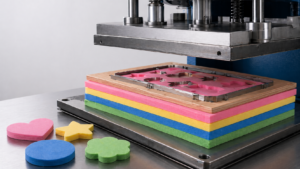
1. What Is an EVA Foam Sticker?
An EVA foam sticker is a sticker-type craft material made by applying adhesive to soft, lightweight EVA foam and cutting it into the desired shape. Unlike ordinary paper or vinyl stickers, it has thickness and feels soft and cushioned to the touch, so it is widely used for children’s crafts and dimensional decorations.
Lightweight and Soft Material
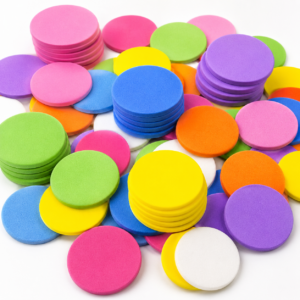
EVA foam is lightweight and cushioned, making it easy to handle by hand. It is less burdensome than hard plastic or wooden parts and can be produced in many colors, making it highly useful as a craft material.
Dimensional Stickers
While paper stickers feel thin when applied, EVA foam stickers have thickness and provide a stronger decorative effect. When attached to cards, frames, teaching aids, signs, or packaging, they create a noticeable dimensional look.
Flexible Shape Production
They can be produced not only in basic shapes such as circles, stars, and hearts, but also as animals, flowers, leaves, letters, numbers, and seasonal decorations. However, due to the material characteristics, very thin lines or small holes may be difficult to produce.
EVA foam stickers are easy to understand as “soft shaped parts that can be attached.” Since they already have adhesive backing, they can be used without separate glue or double-sided tape, and children can easily peel and attach them during craft activities.
2. Basic Structure of EVA Foam Stickers
EVA foam stickers are usually composed from top to bottom of EVA color foam layer, adhesive layer, release liner. Depending on the product, printing, coating, glitter, laminating, or additional decorations may be added, but the basic structure can be understood as shown below.
EVA Foam Layer
This is the main material that creates the actual shape and thickness. It comes in various colors, is lightweight, and feels soft to the touch. Greater thickness improves the dimensional effect, but small shapes or precise inner holes can become more difficult to produce.
adhesive layer
This is the adhesive treatment on the back. The user removes the release liner and attaches the sticker to the desired location. Adhesion may vary depending on the surface material, dust, moisture, temperature, and surface curves.
release liner
This paper protects the adhesive surface and prevents it from becoming contaminated before use. Individual products have separate release liners, while sheet-type products may have multiple shapes arranged on one release liner.
Surface Decoration
Basic EVA foam is a solid color, but it can be decorated in various ways, such as glitter, patterns, printing, pearl effects, punching, or combined attachments. However, the more decoration there is, the more production steps and cost may increase.
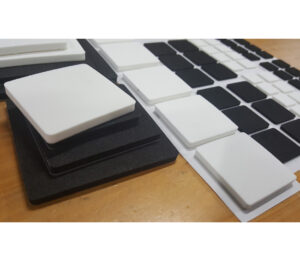
3. EVA Foam Sticker Production Process
EVA foam stickers are not made by simply cutting a shape. They go through material selection, adhesive processing, design cleanup, cutting, inspection, and packing. For sticker-type products in particular, the adhesive layer and release liner condition are important, so choosing the cutting method matters.
4. EVA Foam Sticker Cutting Methods
EVA foam stickers can be understood by distinguishing kiss cutting and full cutting depending on the product type. Depending on production quantity and design difficulty, laser cutting, Thomson die cutting, press cutting, or digital cutting may be used.
Kiss Cutting
This method cuts only through the EVA foam and adhesive layer while leaving the release liner underneath intact. It is suitable for sticker products with multiple shapes on one sheet. Users can peel off only the shape they need and attach it.
Full Cutting
This method cuts through the EVA foam, adhesive layer, and release liner to make individual pieces. It is suitable for individual packing, set assembly, event distribution, and DIY kit parts.
Laser Cutting
This method uses a laser to cut along the shape based on the design file. It is suitable for samples, small quantities, and complex shapes, but because it uses heat, the edge condition, odor, and slight heat marks should be checked.
Thomson Die Cutting
This method makes a die by inserting blades into a wooden board and cuts by pressing it with a press. It is advantageous when producing many pieces of the same shape repeatedly. However, die production costs are required, and design changes are difficult.
Digital Cutting
This method uses a machine with a blade that moves along the file to cut. It leaves fewer heat marks and can be used for samples or small quantities, but cuttability depends on the EVA foam thickness and material elasticity.
For products where users peel multiple shapes from one sheet, kiss cutting looks neat and is easy to use. On the other hand, if pieces need to be individually packed by color or shape, or separated as kit parts, full cutting is more suitable.
5. Uses of EVA Foam Stickers
EVA foam stickers are lightweight, easy to handle safely, and provide a dimensional decorative effect, making them useful in many fields. They are especially used for children’s crafts, kindergarten and elementary school teaching aids, event decorations, DIY kits, and package decoration.
Children’s Craft Materials
Children can create projects by peeling and attaching shapes such as hearts, stars, flowers, animals, eyes, noses, and mouths. They are easy to use even in activities where scissors or glue may be difficult, making them suitable for preschool and children’s craft materials.
Educational Teaching Aids
When made as numbers, Korean letters, alphabet letters, shapes, or color-sorting stickers, they can be used as play-based learning aids. Their thickness makes them suitable for activities where children hold and attach pieces by hand.
Event and Party Decorations
They can be used as decorative stickers for birthdays, Christmas, Halloween, graduation, Children’s Day, and seasonal events. They add dimension to walls, boards, cards, and gift packaging.
DIY Kit Components
By pre-cutting the required shapes and including them in a craft kit, users can easily complete the finished item. Examples include animal face decorating, crown making, frame decorating, and card-making kits.
Package and Gift Wrapping
They create a softer and cuter impression than simple labels and can be used to decorate gift boxes, envelopes, shopping bags, and return gifts. Colors and shapes can also be customized to match the brand mood.
Bulletin Boards and Classroom Decorations
They are useful for decorating bulletin boards in daycare centers, kindergartens, academies, and schools. They can be produced as seasonal flowers, leaves, snowflakes, animals, name tag decorations, and more.
6. Design Notes for EVA Foam Stickers
EVA foam is thicker and more elastic than paper or film. Therefore, thin lines or small holes that look good on screen may be weak or may not separate cleanly in the actual product.
Avoid Lines That Are Too Thin
Because EVA foam is a soft material, overly thin parts may tear or bend. For narrow areas such as letters, animal tails, petal connections, or star tips, it is best to secure enough producible width.
Be Careful with Small Inner Holes
Designs with many small inner holes, such as eyes, buttonholes, or lace patterns, can be difficult to cut and weed. The more small holes there are, the longer production may take and the higher the defect risk may become.
Round Sharp Tips
Designs with pointed tips, such as stars, crowns, or leaves, may lift or become damaged at the tips. Slightly rounding the tips improves usability.
Sheet-Type Products Need Spacing
When placing multiple shapes on one sheet, enough spacing between shapes is needed. If the spacing is too narrow, neighboring shapes may lift together when peeled, or cut lines may overlap and reduce quality.
Consider the Adhesive Surface Environment
EVA foam stickers adhere most reliably to smooth and clean surfaces. Adhesion may weaken on dusty, oily, wet, rough, or curved surfaces.
Check the Final Size
Even if the design looks appropriate on screen, it may be too small when produced in actual millimeter size. If users will peel and attach the product by hand, it is important to check whether it is easy to hold.
Recommended Method for First-Time Production
Rather than starting with mass production right away, it is best to check size, adhesion, peeling feel, and edge condition with sample cutting. For children’s craft kits or educational products, it is especially important that actual users can peel and attach the pieces easily.
7. Comparison by EVA Foam Sticker Product Type
| Product Type | Features | Recommended Uses | Notes |
|---|---|---|---|
| Individual Stickers | Individually cut by shape and ready to use | DIY kits, set packing, event distribution | Sorting by quantity and packing work may be required |
| Sheet-Type Stickers | Multiple shapes arranged on one release liner | Children’s crafts, teaching aids, sticker sets for sale | Spacing between shapes and kiss-cut quality are important |
| Letter and Number Stickers | Korean letters, English letters, numbers, and symbols made from EVA foam | Name tags, learning aids, bulletin board decoration | Fonts with strokes that are too thin may be difficult to produce |
| Seasonal Decorative Stickers | Seasonal designs such as flowers, leaves, snowflakes, Santa, and pumpkins | Kindergarten decorations, event decorations, card decorating | Planning colors and quantities by season is important |
| Combination Craft Sets | A set that combines multiple shapes to make one finished item | Animal face making, crown making, frame decorating | A component list is needed to prevent missing parts |
8. Checklist Before Ordering
When requesting EVA foam sticker production, providing the size, color, thickness, adhesive requirement, quantity, and packing method along with the shape will make the quotation and production consultation much more accurate.
Design Information
- Desired shape: heart, star, animal, flower, letter, etc.
- Final size: width × height in mm
- Whether inner holes are included
- Whether it is sheet-type or individual-piece type
- Whether you have vector files such as AI, SVG, DXF, or PDF
Material Information
- EVA foam color
- Thickness
- Whether glitter, pearl effect, or patterns are needed
- Whether adhesive backing is required
- Release liner color or type
Quantity Information
- Total production quantity
- Quantity by color
- Quantity by shape
- Whether a sample is needed
- Possibility of reorder
Packing Information
- Individual packing
- Packing by color
- DIY kit assembly packing
- Sheet packing
- Whether labels, instructions, or barcodes are needed
Consultation is possible even if you only have a photo or image file, but actual cutting requires a cuttable line design. Complex character or letter designs may require vectorization work.
9. Quality Check Points
Shape Accuracy
Check whether the outline of the actual product is not significantly different from the design and whether there is tearing or compression. Since EVA foam is a soft material, overall shape stability is more important than extremely precise dimensions.
Adhesive Condition
Check whether the adhesive layer remains evenly when the release liner is removed and whether the adhesive shifts or peels off. Adhesion may vary depending on the surface to which it is applied.
Release Liner Peeling
It is important that users can peel it off easily. Especially for children’s products, usability may decrease if the release liner is too difficult to remove.
Edge Condition
Laser cutting may leave slight heat marks or odor, while die cutting may leave compression from blade pressure.
Color Consistency
Even with the same color name, slight color differences may occur by production lot. Sample checking is recommended for products where color is important.
Packing Quantity
For kit components, the quantities by shape and color must be accurate. For products with many parts, it is best to make a component list and inspect against it.
10. Usage Precautions
Check the Surface Before Applying
EVA foam stickers adhere most reliably to smooth and clean surfaces. Adhesion may weaken on dusty, wet, oily, fabric, rough wall, or curved surfaces.
Avoid High-Temperature Environments
In environments exposed to strong heat or direct sunlight for long periods, material deformation or reduced adhesion may occur. These stickers are more suitable for indoor decoration and crafts than long-term outdoor use.
Be Careful with Small Parts
Small EVA foam sticker pieces should be kept from being swallowed by young children. When used for activities with toddlers, adult or teacher supervision is recommended.
Not for Permanent Bonding
General craft EVA foam stickers do not use industrial-strength adhesive. They may not be suitable for applications that require long-term fixation or load-bearing adhesion.
Frequently Asked Questions
Q. How are EVA foam stickers different from ordinary stickers?
Ordinary stickers are often thin materials such as paper or film, while EVA foam stickers are made from soft foam material and have thickness and dimension. This makes them more commonly used as craft materials, educational teaching aids, and decorative components.
Q. Can they be made in the shape I want?
Yes. They can be produced in various shapes such as hearts, stars, animals, flowers, letters, and numbers. However, very thin lines, extremely small holes, or complex inner shapes may be difficult to produce or may require adjustment.
Q. Is the adhesive strong?
It has adhesive strength suitable for craft and decorative use. However, adhesion may vary depending on dust, moisture, oil, curves, and the material of the surface. Separate testing is needed for long-term fixation or outdoor use.
Q. Which is better, sheet-type or individual-piece type?
For sticker sets for sale or children’s activities, sheet-type products look neat and are easy to use. For DIY kits where fixed quantities must be packed by color, or for event distribution, individual pieces may be more convenient.
Q. Can glitter EVA foam be made into stickers?
Glitter EVA foam may also be possible to produce as stickers. However, materials with a surface decoration layer may require different cutting conditions than regular EVA foam, so sample checking is recommended.
Q. Is it safe for children’s crafts?
EVA foam is lightweight and soft, so it is widely used as a children’s craft material. However, small parts may pose a choking risk, so adult or teacher supervision is recommended for younger children.
Summary
| Item | Details | Recommended Criteria |
|---|---|---|
| Small Quantity / Sample Production | Quick testing with file-based cutting | Consider laser cutting or digital cutting |
| Large-Quantity Repeated Production | Quickly cut the same shape repeatedly | Consider Thomson die cutting or press cutting |
| Sheet-Type Stickers | Kiss-cut only the EVA foam while leaving the release liner intact | Sticker sets for sale, children’s crafts |
| Individual Stickers | Cut through the release liner to create individual parts | DIY kits, event distribution, packing by color |
| Intended Use | Crafts, teaching aids, decorations, packaging, classroom displays | Choose thickness, color, adhesive strength, and packing method |
Helpful Information for EVA Foam Sticker Consultation
If you provide the desired shape, actual size, color, thickness, adhesive requirement, sheet-type or individual-piece type, production quantity, intended use, and packing method, we can guide you more accurately on the production method and quotation.