




Understanding Solitone
Solitone(SOLITONE) is one of Shinwon Felt’s representative hard-type color felt sheets. It is stiffer than general soft felt, offers vivid colors, and maintains its shape well after cutting. For this reason, it is widely used for early childhood teaching materials, felt crafts, die-cutting, appliqué, patches, and laser cutting materials. This article explains not only the features of Solitone, but also the principles of nonwoven fabric, manufacturing processes, and the differences between industrial, agricultural, and interior-use nonwoven fabrics.
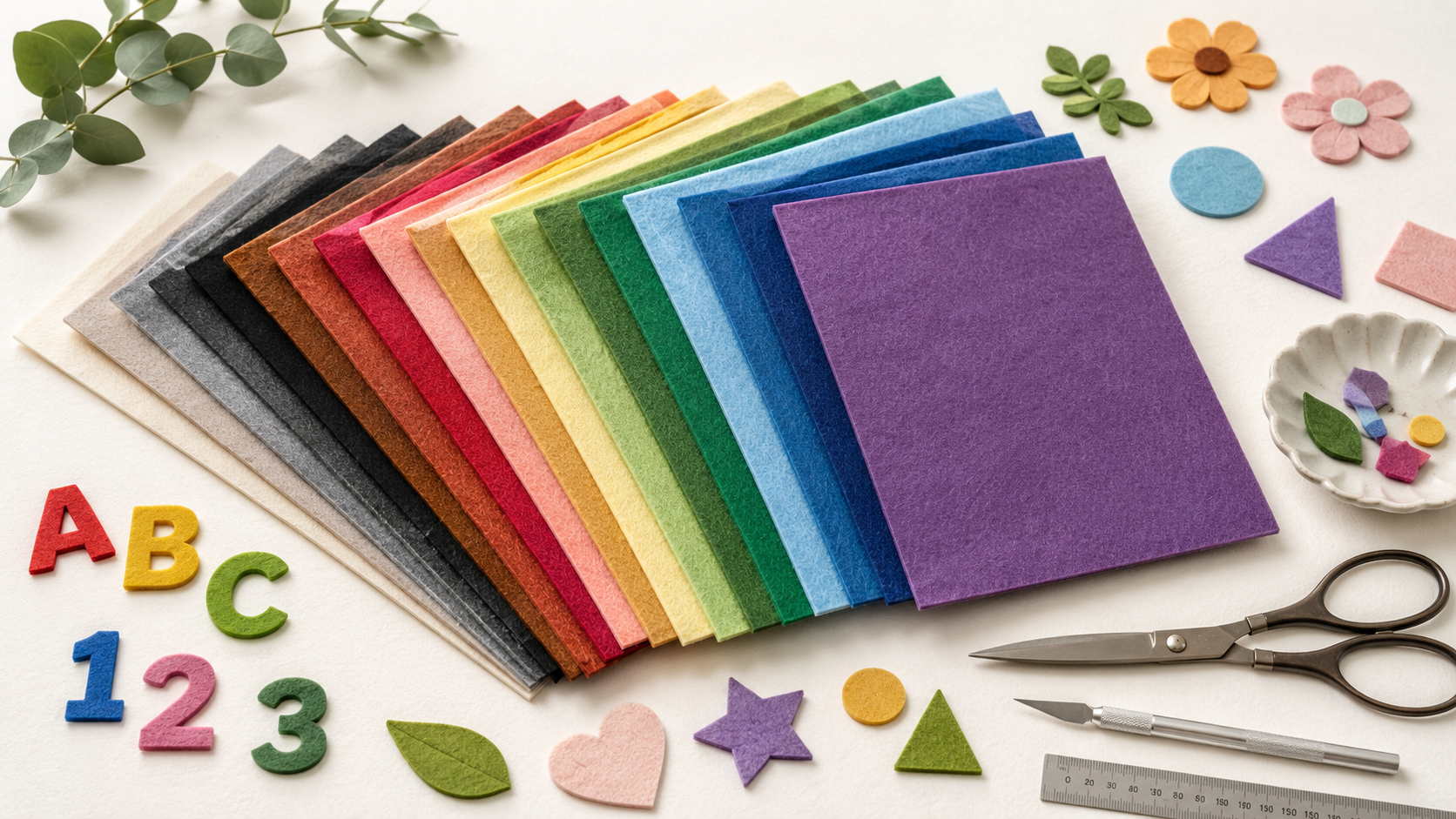
1. What is Solitone(SOLITONE)?
Solitone is a color hard felt product line from Shinwon Felt, commonly referred to as resin-finished felt, hard felt, or hardened resin-treated felt. Rather than being a soft and floppy material like general soft felt, it is closer to a production-use felt sheet that is thin yet has enough firmness to maintain its cut shape stably. In a broad sense, felt is a fiber material belonging to the nonwoven fabric category. Unlike woven fabric, which is made by interlacing vertical and horizontal threads, felt is made by spreading fibers into thin layers and fixing them into a sheet form through pressure, heat, resin, physical entanglement, and other methods. Solitone can be seen as a representative example of nonwoven and felt technology developed into a craft and educational material.| Product Line | Shinwon Felt SOLITONE Hard Felt |
|---|---|
| Fabric Type | Hard felt / Resin-finished felt / Hardened resin-treated felt |
| Typical Thickness | Approximately 1.2mm |
| Typical Width | Sales specifications of around 110cm width are commonly used |
| Sales Format | 30×45cm sheets, 90×110cm one-yard cuts, color sets, rolls, adhesive types, etc. |
| Main Uses | Early childhood teaching materials, toys, felt crafts, die-cutting, laser cutting, patches, embroidery patches, stationery and fancy goods components |
The number of colors, specifications, adhesive availability, and sales units may vary depending on the seller and stock situation. For repeated production, it is recommended to manage colors by color number rather than color name.
2. Key Features of Solitone
The advantages of Solitone do not end with simply being “felt available in many colors.” It is a material where the difference can be felt during actual work processes such as cutting, attaching, sewing, and storing.Firm Hard Type
Thanks to hardened resin processing, the fabric itself has firmness, making it suitable for work where shapes need to hold well, such as small figures, letters, numbers, and flower petals.Clean Cutting Quality
It produces relatively clean edges when cut with scissors, knives, die-cutting tools, or laser cutting, making it suitable for precise component production.Low Pilling and Stable Finish
Compared with general soft felt, the surface is more firmly finished, giving completed items a neat appearance and making it suitable for repeatedly used teaching materials.3. Differences Between Soft Felt and Hard Felt
Not all felt has the same feel. Soft felt is flexible and easy to sew, but it may lack firmness when making small parts or shapes that need to stand. On the other hand, hard felt such as Solitone has strengths in shape retention and cutting quality rather than softness.| Category | Soft Felt | Solitone Hard Felt |
|---|---|---|
| Texture | Soft and flexible | Thin yet firm and stiff |
| Shape Retention | Can bend and sag easily | Cut shapes are maintained relatively well |
| Cutting Work | Small shapes may have less stable edges | Suitable for die-cutting, knife cutting, and laser cutting |
| Recommended Uses | Dolls, sewing, soft accessories | Teaching materials, patches, appliqué, stationery, decorative parts |
4. Differences Between Solitone and General Nonwoven Fabric
Nonwoven fabric is a very broad category of materials. Mask filters, wet wipes, agricultural thermal covers, weed control mats, automotive interior materials, acoustic panels, industrial filters, packaging materials, medical gowns, and felt sheets can all be considered part of the nonwoven fabric family in a broad sense. However, even within nonwoven fabrics, materials can be completely different depending on their purpose. Among them, Solitone is a hard felt focused on color expression, shape retention, clean cutting, and craft or teaching material production.The Standard for Choosing a Material is “Purpose”
If you need to cover crops, agricultural nonwoven fabric is suitable. If you need to filter dust, filter-use nonwoven fabric is appropriate. If wall sound absorption is the purpose, acoustic felt panels are suitable. On the other hand, if you want to make letters, numbers, flowers, characters, teaching materials, patches, or decorative parts, hard felt such as Solitone is more appropriate.| Category | Main Purpose | Important Performance | Typical Uses | Difference from Solitone |
|---|---|---|---|---|
| Solitone Hard Felt | Craft, teaching material, and decoration production | Color, cutting quality, shape retention | Early childhood teaching materials, patches, appliqué, stationery, die-cutting | Focused on color and workability |
| Industrial Nonwoven Fabric | Mechanical and functional performance | Strength, heat resistance, filtration, flame resistance | Filters, automotive interiors, cushioning materials, pads | Focused on functional specifications |
| Agricultural Nonwoven Fabric | Crop protection | Breathability, water permeability, heat retention, UV stability | Crop covers, weed control mats, thermal covers | Focused on outdoor use and crop growth |
| Interior Nonwoven Fabric | Space finishing, sound absorption, decoration | Sound absorption, thickness, flame resistance, texture | Acoustic panels, wall decoration, furniture interior materials | Focused on spatial performance and installation |
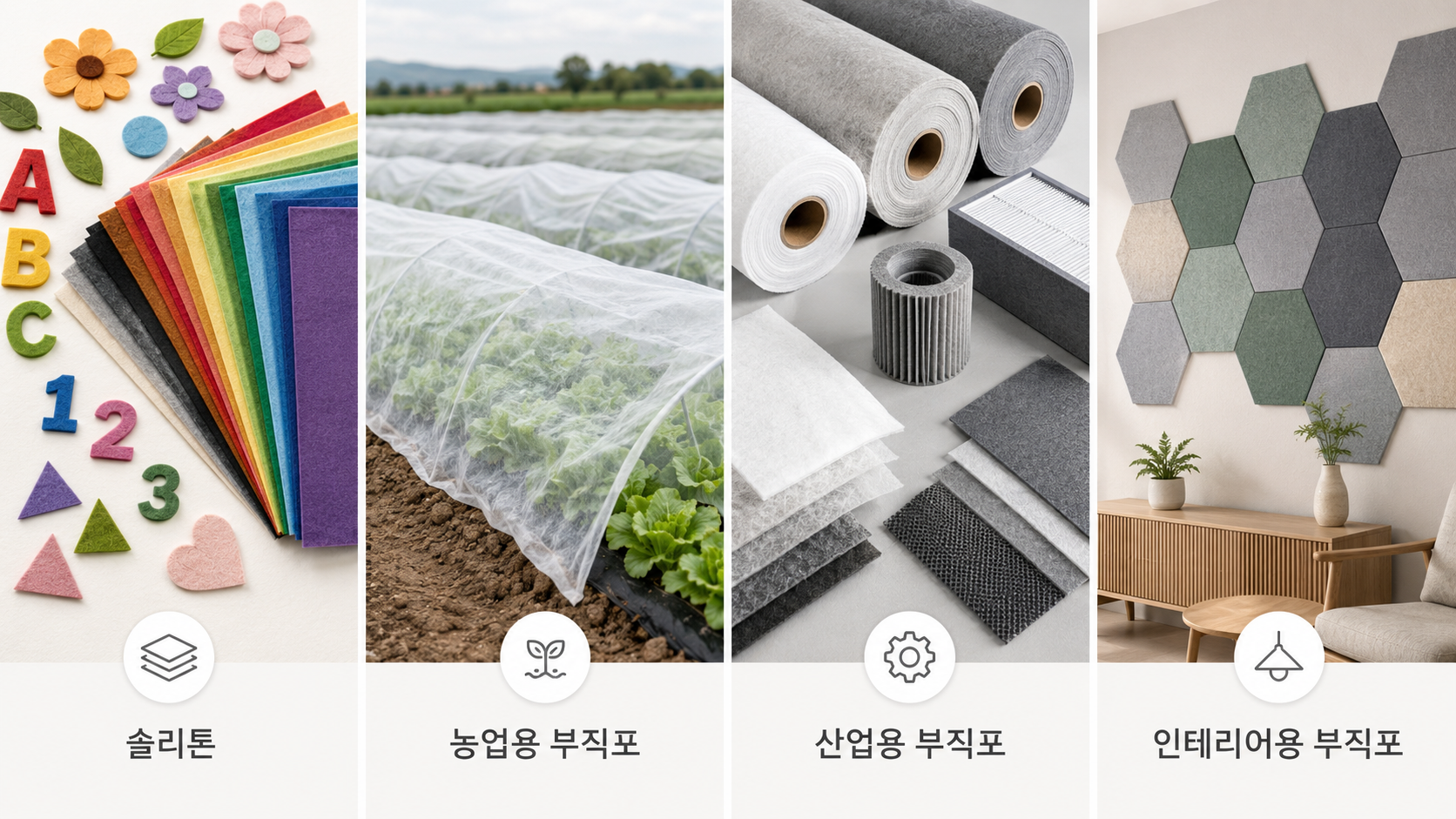
5. Differences from Industrial, Agricultural, and Interior Nonwoven Fabrics
Industrial Nonwoven Fabric
For industrial nonwoven fabric, performing a specific function is more important than looking attractive. Filter-use nonwoven fabric needs to filter dust or particles effectively, while nonwoven fabric for automotive interiors requires durability, sound absorption, flame resistance, and formability. If industrial nonwoven fabric is “a material that works inside machines,” Solitone is “a material that shines during the process of being seen, touched, and made by people.”Agricultural Nonwoven Fabric
Agricultural nonwoven fabric is used to protect crops. Crop covers, frost protection covers, weed control mats, and thermal covers require light transmission, water permeability, airflow, temperature control, and UV stability. In contrast, Solitone is a color hard felt made for indoor production, teaching materials, decoration, patches, crafts, die-cutting, and laser cutting.Interior Nonwoven Fabric
Interior nonwoven fabric is used for wall finishing materials, acoustic panels, decorative panels, furniture interior materials, and exhibition displays. In this field, elements such as sound absorption, flame resistance, thickness, workability, and stain resistance are important. Solitone can also be used for exhibition decoration or small display materials, but it is best to distinguish it from materials that require performance certification, such as large acoustic panels or architectural finishing materials.6. The Origins of Nonwoven Fabric and Felt
Felt is known as one of the oldest fiber materials used by humankind. Even before spinning yarn and weaving textiles, people empirically understood that animal hair or fibers could become entangled into a firm sheet-like form through moisture, heat, pressure, and friction. In particular, in Central Asian nomadic cultures, wool felt was used for tents, clothing, shoes, saddles, rugs, and cold-weather materials. In modern times, felt and nonwoven fabrics have expanded beyond natural wool to include various synthetic and regenerated fibers such as polyester, polypropylene, nylon, and rayon.7. Basic Manufacturing Principles of Nonwoven Fabric
The core of nonwoven fabric manufacturing is “spreading fibers into a thin layer and bonding that fiber layer into a sheet.” Woven fabric is made by interlacing vertical and horizontal yarns, but nonwoven fabric is not woven. Instead, short fibers or long filament fibers are formed into a thin fiber layer called a web, and then the fibers are fixed together through methods such as heat, pressure, resin, and mechanical entanglement.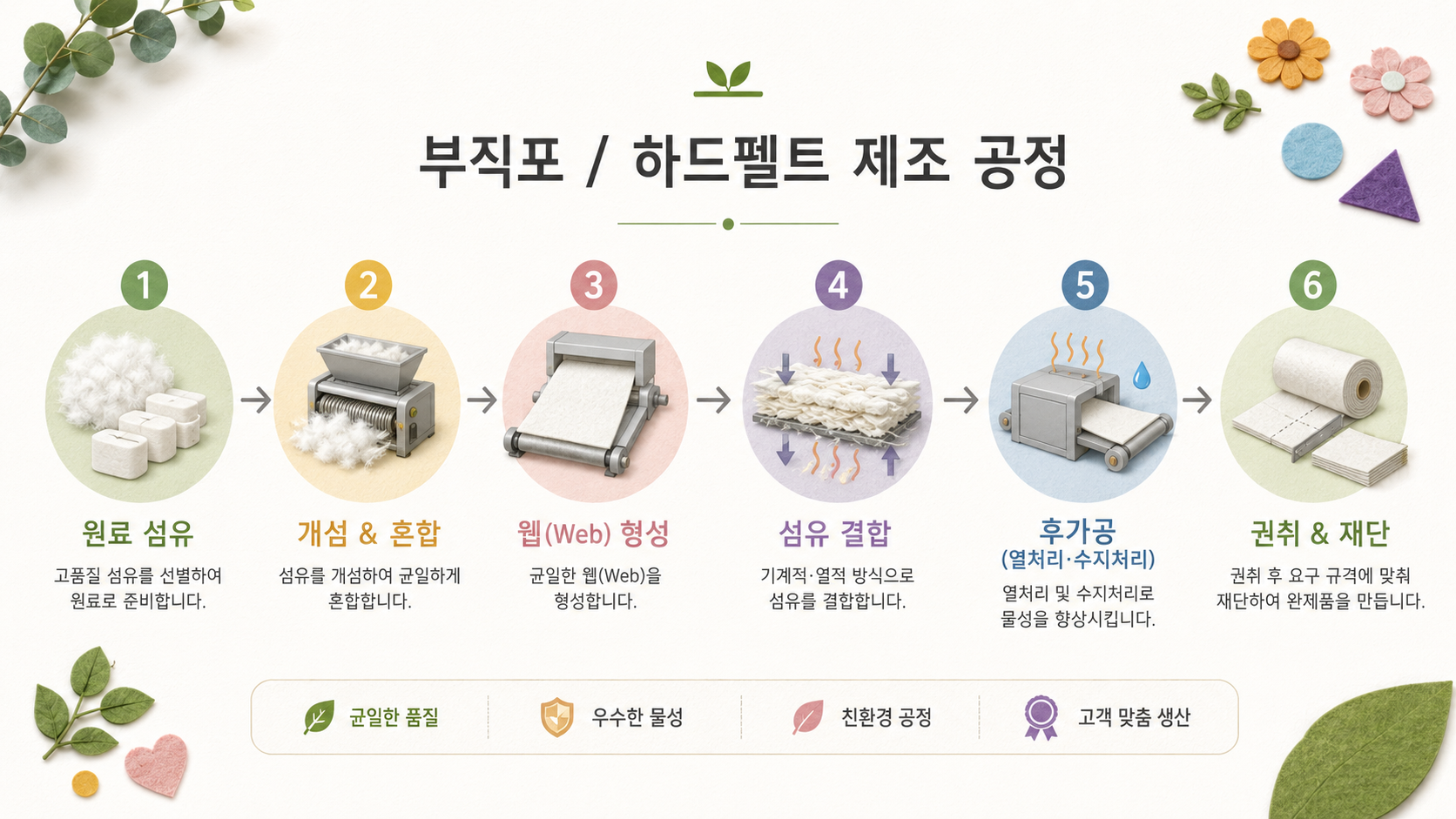
8. Bonding Processes and Post-Processing
The fiber layer immediately after web formation is still weak. Since it can easily lose its structure when pulled by hand, nonwoven fabric requires a process that bonds the fibers together after the web is formed. Bonding methods can be broadly divided into mechanical bonding, thermal bonding, and chemical bonding.Mechanical Bonding
This is a method of entangling fibers with needles or physical force. In needle punching, special needles repeatedly pierce the fiber layer, entangling fibers up and down.Thermal Bonding
This is a method of softening or melting part of the fibers with heat and pressure to bond them together. Surface texture and thickness can be adjusted using calendar rollers or hot-air devices.Chemical Bonding
This is a method of fixing fibers by impregnating or coating the fiber layer with binder or resin. The resin-finished feel of hard felt is closely connected to this process or post-processing concept.Heat Treatment and Calendaring
Heat treatment can be used to stabilize the dimensions of the fabric and refine the surface. Calendaring is a process in which the fabric passes between heated rollers or pressure rollers to flatten the surface and adjust thickness.Resin Treatment and Adhesive Processing
Resin treatment is used to give fabric firmness, shape retention, and surface stability. This is an important feature of resin-finished hard felt such as Solitone. Adhesive-type products are made by adding an adhesive layer to the back so they can be used like stickers.9. What Kind of Material is Solitone from a Manufacturing Perspective?
If Solitone is viewed simply as “colored felt,” its advantages are not fully apparent. From a manufacturing perspective, Solitone is a color hard felt whose physical properties have been adjusted for craft and educational use.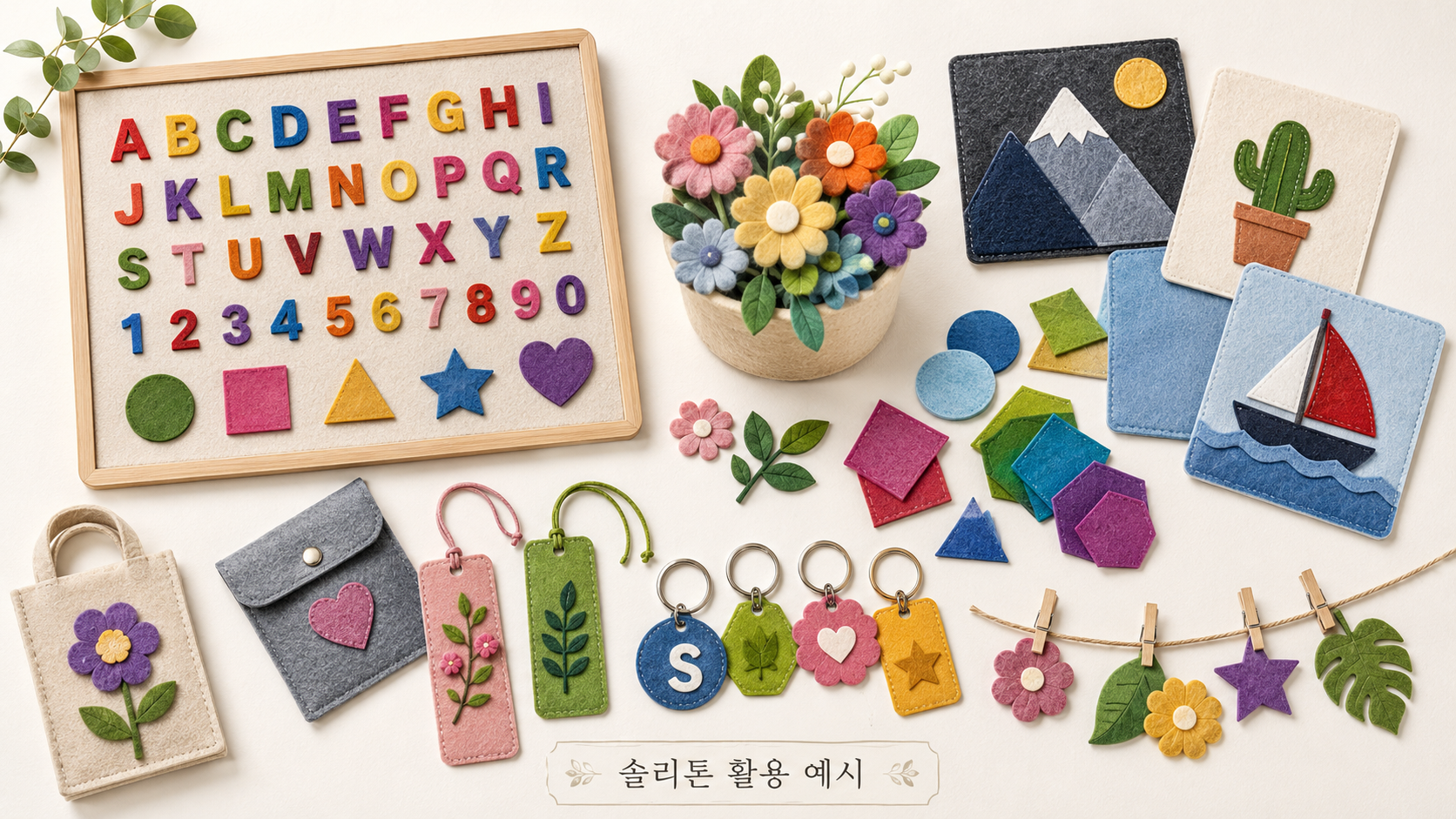
10. Main Applications
Because Solitone holds its shape well and offers vivid colors, it is especially widely used in children’s educational materials and precision craft areas.11. Things to Check Before Purchasing
When purchasing Solitone, it is better to check the specifications and processing options that match your work purpose rather than choosing only by color.Adhesive / Non-Adhesive Type
Non-adhesive type is flexible for sewing, glue, and hot glue work, while adhesive type is convenient because it can be attached like a sticker.Calculating the Required Size
For small-volume work, sheets or color sets are suitable. For repeated production, one-yard cuts or rolls are more efficient.Managing Color Numbers
Monitor colors and actual colors may differ, so for repeat orders it is recommended to keep records based on color numbers.Laser Cutting Test
Edges and scorch marks may vary depending on color, thickness, and adhesive type, so sample testing is recommended before mass production.Checking the Cutting Unit
When ordering multiple yards, checking whether the fabric is cut into separate pieces or supplied as a continuous length can reduce work loss.Storage Method
Store sheets flat, and store one-yard fabric rolled up to reduce fold marks and pressure marks.Conclusion: Solitone is “a color hard felt that holds its shape cleanly”
Solitone is not just an ordinary felt sheet, but a representative hard felt material that enhances the finish of craft, education, and design work. It is thin yet firm, offers a wide range of color choices, cuts cleanly, and maintains its shape well, making it useful for many types of projects. In particular, if your work requires small shapes and vivid colors, such as early childhood teaching materials, die-cutting, laser cutting, appliqué, patches, or fancy goods accessories, Solitone is a felt sheet worth considering first.