




Felt Processing Guide
The Difference Between Laser Cutting and Thomson Die Cutting
Felt products are not simply about “cutting.” The suitable processing method changes depending on shape, quantity, thickness, precision, and whether the item will be produced repeatedly. This page explains the principles, pros and cons, production process, and key points to check before ordering, focusing on Laser Cutting and Thomson Die Cutting, which are commonly used for felt cutting.
Laser cutting is often better for small quantities, many variations, and complex shapes, while Thomson die cutting is often better when producing the same shape repeatedly in large quantities. However, the best choice may vary depending on the felt thickness, color, material, design structure, and quantity.
Why Is Choosing the Right Felt Cutting Method Important?
Felt is not a rigid material like paper. It is a fibrous material whose compression, stretching, and recovery vary depending on thickness and density. For this reason, even with the same design, the edge finish, dimensional stability, production cost, and lead time can differ depending on the cutting method.
Shape
The more complex the outline, such as circles, stars, hearts, letters, or animal shapes, the more important the cutting method becomes. Designs with many inner holes or repeated small curves can show a significant difference in results depending on the processing method.
Quantity
The suitable method depends on whether you need only a few samples or hundreds or thousands of repeated pieces. A method with a low initial cost may differ from one with a low unit cost for mass production.
Edge Finish
Laser cutting uses heat, so the edge may slightly melt or become firmer. Die cutting cuts with blade pressure, so slight compression marks or fine fiber texture may remain.
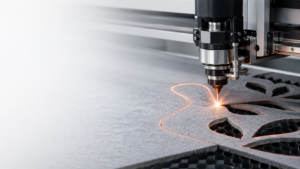
1. Understanding Laser Cutting
Laser cutting is a method that cuts material by focusing a high-power laser beam onto a very small point. Because it can cut based on a digital design file without producing a physical blade or die, it is suitable for complex shapes, small quantities, and sample production.
Generates light energy
Cuts the focused area
Basic Principle of Laser Cutting
A laser is a strong beam of light concentrated in one direction. When this light is focused through a lens onto a very small area of the felt surface, that area heats instantly, and the material melts or vaporizes to create a cut line. The cutting head moves along the lines of the design file to cut the desired shape.
Characteristics on Felt
Because felt is made of interlocked fibers, laser cutting may slightly seal or tidy the fibers at the edge. However, depending on the material, color, and thickness, the edge may become slightly harder, and slight scorching, odor, or heat marks may occur.
When Laser Cutting Is Advantageous
- Sample production or small quantities
- Designs with complex shapes and many curves
- Letters, logos, characters, and decorative parts
- When the design needs to be changed frequently
- When testing is needed before making a die
Points to Note
- Because it uses heat, the edge feel may change.
- Scorching or discoloration may be more visible on light colors.
- Thicker felt may require slower cutting speeds or multiple passes.
- Very small holes or thin lines may tear or bend due to the nature of the material.
- Due to the nature of laser cutting, a small cut width, or kerf, is created.
Parts that are too thin in the design can easily bend or tear when made with felt. When cutting letters or logos from felt, it is best to secure enough stroke width. Designs with many inner holes may also require more cutting and finishing time.
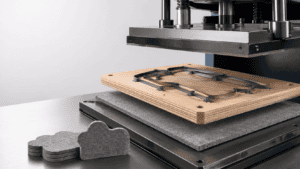
2. Understanding Thomson Die Cutting
Thomson die cutting is also commonly called domusong, punching, or die cutting. It uses a wooden board fitted with cutting blades in the shape of the design, then presses the felt fabric with a press machine to cut out the shape in one operation. It is a stable and efficient method when producing the same shape repeatedly in large quantities.
What Is a Thomson Die?
A Thomson die is a cutting die made by inserting blades into a wooden board according to the design shape. The blades may include cutting blades for outlines, creasing blades for fold or indentation lines, and perforation blades for dotted tear lines. In felt processing, it is mainly used for cutting outer outlines and inner holes.
Basic Principle of Die Cutting
The die is placed on the prepared felt fabric, and the press applies strong pressure from above. The blades in the die pass through the felt and cut it into the design shape. Since the same shape can be produced repeatedly with one press operation, productivity is high for mass production.
Understanding Press Types
Flatbed Press
This method places the die and material between upper and lower flat plates and applies pressure. It can press a wide area relatively evenly and is used for cutting various sheet-type materials.
Clicker Press
This type of press is widely used for soft materials such as shoes, leather, textiles, and rubber. It is suitable for repeated cutting where the operator positions the die and presses repeatedly.
Roller / Rotary Cutting
This method cuts with a roller or rotary die while continuously feeding the fabric. It is advantageous for mass production, but the equipment and die conditions must be suitable.
When Thomson Die Cutting Is Advantageous
- When producing the same shape repeatedly in large quantities
- Highly repeatable designs such as circles, squares, or simple character outlines
- When product specifications are fixed and long-term reorders are expected
- When you want to avoid laser heat marks
- When cutting speed and unit cost are important
Points to Note
- Die production costs may be charged separately.
- If the design changes, the die may need to be modified or remade.
- Very small holes or complex inner shapes may be difficult to produce.
- If the material is thick or highly elastic, compression marks or dimensional variations may occur.
- Die blades can wear with repeated use and require maintenance.
A die is best understood as a tool for repeated production after the design has been finalized. Therefore, instead of starting with mass production right away, it is safer to check a sample with laser cutting first if needed, then move to die production once the final design is confirmed.
3. Comparison of Laser Cutting and Thomson Die Cutting
Neither method is always better than the other; they serve different production purposes. The table below summarizes the most commonly compared points when requesting felt cutting.
| Category | Laser Cutting | Thomson Die Cutting |
|---|---|---|
| Processing Principle | Cuts along the design line using the heat energy of a laser beam | Cuts by pressing blades embedded in a die |
| Initial Cost | No die is required, making it advantageous for small quantities | Die production costs may be required |
| Mass Production | Cutting time accumulates as the quantity increases | Once the die is made, repeated production is fast |
| Design Changes | Can be changed relatively easily by editing the file | The die may need to be modified or remade |
| Complex Shapes | Good for curves, letters, logos, and small decorations | Very complex or small shapes may be limited |
| Edge Characteristics | The edge may become slightly firm or scorched due to heat | Cut by blade pressure, so heat marks are minimal but compression may occur |
| Recommended Use | Samples, small quantities, many variations, complex designs | Repeated production, standardized products, mass production |
When Laser Cutting Is Recommended
For product development, sample production, small orders, or products with complex outlines such as letters and logos, laser cutting is a good first choice. It is also advantageous when design revisions are frequent or when several designs need to be tested at once.
When Thomson Die Cutting Is Recommended
If the same shape will be produced repeatedly or in steady quantities, die cutting is efficient. Although initial die costs may occur, it can be advantageous in work speed and unit cost for repeated production.
4. Checklist Before Ordering Felt Cutting
Cutting quality depends on how clearly the design, material, quantity, and tolerance are specified. Checking the items below in advance will make quotation and production consultation much more accurate.
Design Information
- Final size: width × height in mm
- Outer outline and inner hole positions
- Minimum stroke width for letters or logos
- Required file formats: AI, SVG, DXF, PDF, etc.
- Whether vector tracing is needed when only image files are available
Material Information
- Felt type: regular felt, hard felt, adhesive felt, etc.
- Thickness: 1 mm, 2 mm, 3 mm, etc.
- Color: light colors require checking for heat marks
- Fabric width and cuttable area
- Whether double-sided tape, adhesive backing, or reinforcement is attached
Quantity Information
- Separate sample quantity and main production quantity
- Whether there is one design or multiple designs
- Quantity by color
- Whether reorders are expected
- Delivery schedule
Quality Standards
- Allowed dimensional tolerance
- Whether edge scorching is acceptable
- Whether compression marks are acceptable
- Packing unit
- Whether it is for finished-product assembly or as a component
If This Is Your First Time Producing the Design
Rather than starting with mass production right away, we recommend checking the actual size and edge condition with sample cutting first. Designs with logos, letters, small holes, or thin lines may look different on screen than as actual felt products.
5. Points to Note When Creating a Cutting Design
Avoid Parts That Are Too Thin
Because felt is a fibrous material, overly thin lines or sharp tips can easily bend or tear. Even if such parts are possible for decoration, it is best to allow enough minimum width for parts that will receive force during use.
Allow Enough Space for Small Holes
Small round holes or narrow grooves may not keep their shape perfectly after cutting. Especially with thicker felt, it is more stable to design inner holes with enough size.
Prepare the Design as Lines
Cutting is based on outline information, not filled color areas. If only an image file is available, it must be converted into actual cuttable lines.
Consider a Die for Repeated Production
It can be efficient to test with laser cutting first, then consider a Thomson die once the shape and quantity are confirmed. The more repeated production there is, the greater the advantage of die cutting.
Edge Differences by Color
Even with the same felt, the cut edge may look different depending on the color. Slight heat marks may be more visible on light colors and less noticeable on darker colors.
Consider the Final Use
The required strength and finishing standards differ depending on the purpose, such as decoration, education, packaging components, DIY kits, or apparel accessories. Letting us know the intended use helps us choose the right method.
Frequently Asked Questions
Q. Which is more accurate, laser cutting or die cutting?
It is difficult to compare them by accuracy alone. Laser cutting is good for creating detailed shapes from digital designs, while die cutting is good for producing the same shape repeatedly and consistently. Because felt itself is flexible, it is important to consider the overall shape, purpose, and repeatability rather than only extremely fine dimensions.
Q. Does laser cutting create a burnt smell?
Because laser cutting uses heat, a temporary smell may occur depending on the material. It often decreases with ventilation and storage after processing, but if the application is sensitive to odor, sample checking is recommended.
Q. Can a die be used continuously once it is made?
In general, it can be reused when producing the same design repeatedly. However, its lifespan may vary depending on usage volume, material thickness, press pressure, and blade condition. Long-term use may require blade adjustment or remaking.
Q. Can small letters be cut from felt?
It depends on the letter size, stroke width, font shape, and felt thickness. Very small letters may have blocked inner spaces or weak strokes, so sample checking before production is recommended.
Q. Can production proceed without a design file?
Consultation is possible even if you only have an image or photo, but actual cutting requires a cuttable vector design. If design cleanup is needed, additional cost or time may be required depending on the difficulty.
Summary
| Situation | Recommended Method | Reason |
|---|---|---|
| When you want to check a sample first | Laser Cutting | Can be tested quickly from a file without making a die |
| Complex characters, letters, and logos | Laser Cutting | Suitable for detailed curves and small shapes |
| Mass production of the same shape | Thomson Die Cutting | Efficient for repeated production after the die is made |
| When the design changes frequently | Laser Cutting | Can be handled by editing the file |
| Long-term repeated orders expected | Thomson Die Cutting | Good productivity for reorders after initial die production |
Helpful Information for Felt Cutting Consultation
If you provide an image or design of the desired shape, actual finished size, felt thickness, color, quantity, intended use, and whether a sample is needed, we can guide you to the more suitable method between laser cutting and Thomson die cutting.